
Sustainability

Our Coffee-Ground Material & Sustainability

Every product in the Kaffy corporate range starts as spent coffee grounds — waste from Malaysian cafés, offices and hotels — pressed into a solid upcycled material in our own factory. One material, one local loop, one documented story from pantry bin to boardroom gift.
Last updated: 27 July 2026

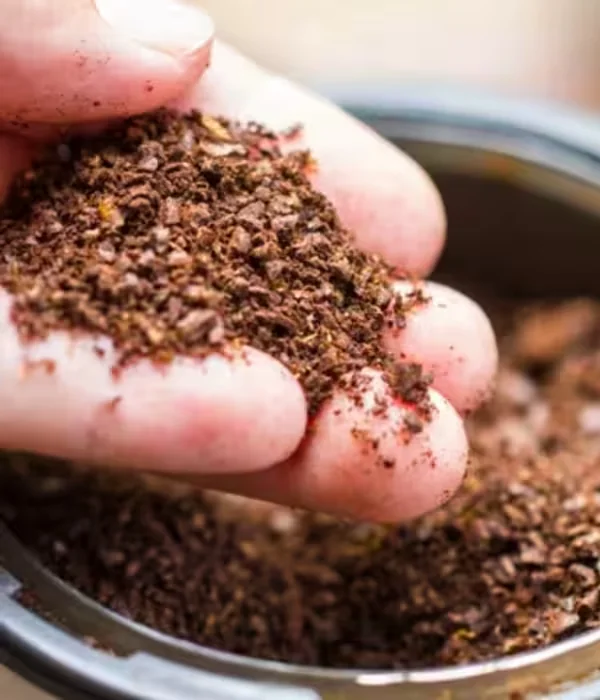
Hand holding freshly collected spent coffee grounds

Most "eco" corporate gifts ask you to take the sustainability claim on faith. A bamboo tumbler shipped across an ocean, a recycled notebook with no origin trail — the label says green, but nobody can show the receipts. Kaffy is built the other way around. The material begins as waste your own city produced this week, gets collected by weight, and leaves our factory as a desk piece, gift set or furniture panel with the paperwork attached.

This page is the material's biography: what it is made of, why spent grounds need rescuing in the first place, how a wet pantry-bin waste becomes a laser-engraved corporate gift, how the finished products perform, and — the part your procurement and sustainability teams care about — what your company can defensibly claim when you gift them. Before the detail, here is the upcycling idea in action.

What is Kaffy's coffee ground material made of?

Quick answer

Mostly spent coffee grounds, held together by plant-based binders, with natural mineral fillers for strength — no alcohol-based finishes and no pork-derived inputs, ever. That composition is what makes the eco corporate gift range both genuinely upcycled and halal-safe by policy.

The recipe matters because it decides everything downstream — durability, texture, aroma, engraving quality and end-of-life. The table below shows the typical composition band of Kaffy's pressed material. Exact ratios vary by product line (a coaster and a furniture panel need different strength), but the principle never changes: the majority of the material is rescued waste.

Three things follow from that recipe. First, the material keeps a warm coffee-brown tone and a faint roast aroma — recipients recognise what it is the moment they pick it up, which is the whole point of gifting it. Second, because the binder system is plant-based and finishes are alcohol-free, the halal-safe policy is built into the material itself, not bolted on at packing. Third, the surface takes laser engraving cleanly, burning your logo a shade darker than the base — no stickers, no ink, nothing to peel.

Typical Composition of Kaffy's Pressed Coffee Ground Material (Illustrative)

Illustrative composition bands compiled by Kaffy, 2026. Exact ratios vary by product line and are tuned per form factor.

Key takeaway

Kaffy's material is majority rescued waste by weight, bound with plant-based inputs — so the upcycled claim and the halal-safe policy are properties of the recipe itself, not marketing added afterwards.

What happens to spent coffee grounds without upcycling?

Quick answer

Almost all of them go to landfill with general waste, where organic matter breaks down without oxygen and releases methane. Only a small share gets composted, and a smaller share still gets upcycled — the gap our coffee grounds collection programme exists to close.

Malaysia drinks a lot of coffee — every mall kiosk, kopitiam, office pantry and hotel breakfast line produces a daily bin of wet, heavy grounds. Because spent grounds are classed as ordinary food waste, the default route is the general bin, then the landfill. That is a double loss: the material's structure and character are thrown away, and its decomposition in landfill produces methane, a far more potent greenhouse gas than carbon dioxide when organic waste rots without oxygen. The chart below shows our working estimate of where café and office grounds end up today.

The imbalance is the opportunity. Grounds are clean, consistent, already ground to a fine particle size, and generated in predictable daily volumes at known addresses — from a manufacturer's point of view, they are close to a perfect feedstock that the waste system treats as worthless. Every kilogramme our partners divert moves a bar in that chart, and every Kaffy gift on a desk is a small, visible argument that the landfill route was never necessary.

Where Spent Coffee Grounds End Up in Malaysia (Illustrative Estimate, 2026)

DestinationEstimated share of groundsShare
Landfill with general waste
80%
Home / garden compost
12%
Animal feed / other reuse
5%
Upcycled into products
3%

Illustrative estimates compiled by Kaffy from collection-partner conversations, 2026. Directional, not audited waste statistics.

Key takeaway

Spent grounds are a near-perfect manufacturing feedstock stuck on a landfill route — upcycling them into pressed products turns a methane liability into a branded asset your company can hand out.

How does a spent ground become a corporate gift?

Quick answer

Five steps, one factory: collect, dry and clean, mix and press, cure and finish, then engrave. Because the whole line sits under our roof — including the custom logo laser engraving — the journey from pantry bin to branded gift is traceable end to end.

Here is the production loop, in the order it happens:

The point of listing the steps is not the chemistry — it is the accountability. At no stage does the material leave our control, which is why MOQs from around 50 units and lead times from about four weeks are promises our own production line sets, not estimates relayed from an overseas factory.
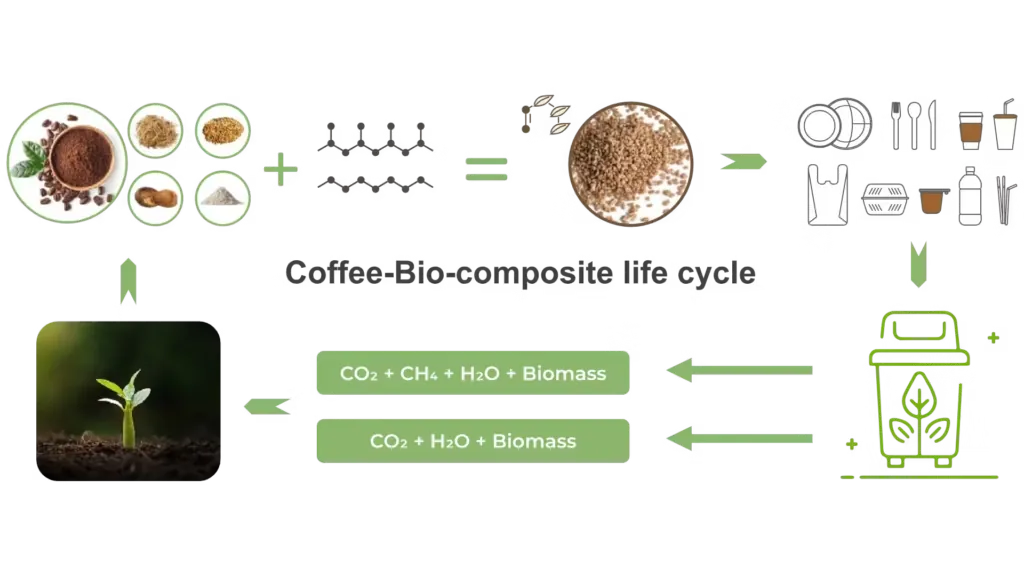
Diagram of the Kaffy coffee bio-composite life cycle
  • Collect from local partners. Cafés, offices and hotels hand over their spent grounds through scheduled pickups, logged by weight per partner — the numbers that later feed diversion records.
  • Dry and clean. Wet grounds are dried to stop mould and remove residual oils, then screened for foreign objects. Drying is the step that turns perishable food waste into a stable raw material.
  • Mix and press. The dried grounds are blended with plant-based binder and natural fillers, then pressed under heat into product forms — coasters, desk pieces, panels — in our own moulds.
  • Cure and finish. Pressed pieces are cured for hardness, then sanded and sealed with alcohol-free finishes, keeping every product halal-safe by policy.
  • Engrave and pack. Your logo is laser-engraved in-house, quality-checked, and packed with the order's upcycled-origin documentation ready for your event or ESG file.
Key takeaway

Five steps on one factory floor take grounds from pantry bin to engraved gift — and because Kaffy owns every step, the traceability your auditors want is a by-product of how we already work.

How does the coffee ground material perform in daily use?

Quick answer

Like a dense hardwood with a story. The material is solid enough for daily desk use and even structural enough for our sustainable office furniture line, engraves cleanly, and ages gracefully — the comparison below sets it against the two materials it usually replaces.

A sustainable gift that fails in use is a liability, not a story — so buyers rightly ask how pressed grounds compare with the plastic and imported wood they normally order. The honest answer: different strengths, and the differences mostly favour the upcycled option for gifting.

Two practical notes buyers ask about. The aroma is subtle and fades to a faint background note within weeks — recipients notice it when they first unbox, which is exactly when you want the story to land. And the material is sealed against normal spills and handling; it is a desk-life material, happiest as coasters, organisers, awards, clocks and panels rather than as items soaked daily on a dish rack.

Kaffy Coffee Ground Material vs Virgin Plastic vs Imported Wood (Illustrative Comparison)

DimensionKaffy pressed-grounds materialVirgin plastic giftImported wood gift
Origin storyUpcycled Malaysian waste, weight-logged per orderNew fossil-based resin, no story to tellVirgin timber, origin often untraceable
Branding methodLaser engraving, permanent, done in-housePrinted or stickered, wears off with handlingEngraving possible, usually outsourced
Feel & characterDense, warm-toned, subtle coffee aromaLight, uniform, reads as disposableWarm but generic — no sensory signature
Daily durabilityHardwood-like; suits desk pieces to furniture panelsDurable but scratches and clouds over timeDurable; can warp in humid offices
End of lifeMajority-organic content, kept in use for yearsCenturies in landfill if binnedBiodegradable but new trees were felled for it

Illustrative comparison compiled by Kaffy, 2026. Directional, for planning; individual products and suppliers vary.

Key takeaway

The material performs like a dense hardwood with a built-in origin story — permanent engraving, desk-grade durability and a sensory signature no plastic or generic wood gift can match.

Want to feel the material before you commit?

Tell us your occasion and volume — we can arrange samples with your quote.

What can your ESG or CSR report actually claim?

Quick answer

A specific, order-level claim: this many gifts, made from roughly this many kilogrammes of diverted Malaysian coffee grounds, produced locally and halal-safe by policy. That is the evidence standard behind our ESG corporate gifts — a documented line, not an adjective.

Sustainability reporting has tightened. Vague "eco-friendly gifts were distributed" lines invite greenwashing questions; what reporting teams want is a number they can trace. Because collection is weight-logged and each product's grounds content is known from the recipe, a Kaffy order converts directly into an approximate diversion figure. The table below shows the illustrative arithmetic at common order sizes, based on a typical desk-gift containing around 100 g of spent grounds.

The claim structure your report can use has three parts, each backed by our records:

Companies that supply their own pantry grounds through the collection programme can go one step further and report a closed loop: their own waste returning as their own sustainable corporate gifts. Few ESG lines read better than "our gifts are made from our own coffee".

Illustrative Grounds Diverted by Corporate Order Size (Typical 100 g Desk Gift)

Order size · Grounds diverted (approx.) · Roughly equal to

Illustrative arithmetic by Kaffy, 2026, assuming ~100 g grounds per desk gift and ~20 g grounds per brewed cup. Actual figures vary by product and are documented per order.

  • Environmental. "Our corporate gifts diverted approximately X kg of spent coffee grounds from Malaysian landfill" — traceable to weight-logged collections and the order's product recipe.
  • Social. "Gifts were halal-safe by policy and locally produced" — fair across a Malay, Chinese and Indian workforce, with Malaysian jobs in the loop.
  • Governance. "Claims are supported by order-specific documentation from the manufacturer" — the sentence that survives an audit, because we are the maker, not a reseller quoting a brochure.
Key takeaway

A Kaffy order converts into an order-specific diversion figure your ESG report can cite — environmental, social and governance lines all traceable to the maker's own records.

Conclusion: a material you can trace, a claim you can defend

Sustainability in corporate gifting usually fails at the same point: the moment someone asks for evidence. Kaffy's coffee ground material is built to survive that moment. The grounds are collected locally and logged by weight, the recipe is majority rescued waste bound with plant-based inputs, the pressing and laser engraving happen on one Malaysian factory floor, and every order leaves with documentation your ESG or CSR file can cite. Halal-safe by policy, MOQs from around 50 units, lead times from about four weeks.

If the material story brought you here, the natural next steps are the Kaffy corporate gifts hub for the full B2B offer, the grounds collection programme if your office or café wants to feed the loop, and the quote form when you are ready to put the material to work for your brand.
World map rendered in spent coffee grounds

From Waste to Product – The Upcycling Principle Behind Kaffy's Material

Source video: How A Company In Berlin Is Turning Coffee Grounds Into Reusable Cups on YouTube

Frequently Asked Questions

What exactly is Kaffy's coffee ground material?
Is the material durable enough for daily use?
Do the products smell like coffee?
Are the materials halal-safe?
How does Kaffy document the sustainability claim for our report?

Ready to turn coffee waste into your company's story?

Tell us your occasion, quantity and budget — we'll propose upcycled products, engraving mock-ups and the diversion documentation your ESG file needs.